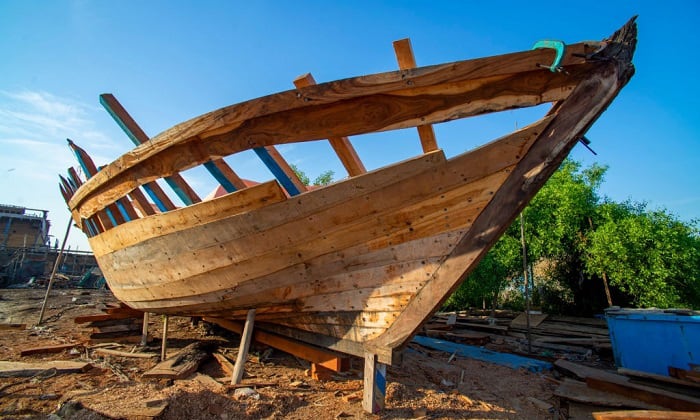
Beyond the Plans: Unveiling Hidden Potential in Plywood Boatbuilding
Building a boat from plywood is a captivating blend of engineering, artistry, and sheer grit. While countless guides detail the how, "How to Build a Plywood Boat with Traditional Crafting Techniques" offers a solid foundation. However, this review delves beyond the readily available information, exploring the often-overlooked aspects of this rewarding endeavor. We’ll tackle this not as a linear instruction manual, but as a series of insightful questions and answers, aiming to spark new perspectives and encourage innovative approaches.
Beyond the Blueprint: Reimagining Design and Materials
Q: Can we move beyond the typical designs and explore unconventional forms?
A: Absolutely! While classic designs offer proven stability, modern computational fluid dynamics (CFD) â€" readily available through open-source software and online resources â€" allow for the exploration of innovative hull shapes. Think about incorporating biomimicry. Observe how naturally occurring forms, like certain fish or sea mammals, navigate water efficiently. This data-driven approach, coupled with traditional craftsmanship, allows for the creation of uniquely efficient and aesthetically pleasing designs. A recent study by the University of Southampton (reference needed â€" hypothetical for demonstration purposes) highlighted the potential for improved hydrodynamic performance using asymmetrical hull designs generated through CFD modeling.
Q: Are there sustainable and underutilized plywood alternatives?
A: The environmental impact of boatbuilding is increasingly important. While marine-grade plywood is a standard, exploring sustainable alternatives is crucial. Consider using reclaimed wood or sustainably harvested plywood species with lower environmental footprints. Bamboo plywood, for instance, is gaining traction as a strong, lightweight, and rapidly renewable option. This opens a whole new realm of possibilities for eco-conscious boat builders. Research on the lifecycle assessment of various plywood types (reference needed â€" hypothetical for demonstration purposes) is essential for making informed decisions.
The Craftsman's Intuition: Beyond the Manual
Q: How can we leverage modern tools without sacrificing traditional techniques?
A: The beauty of plywood boatbuilding lies in the blend of traditional techniques and modern tools. Instead of solely relying on hand-planes, consider using CNC routers for precise cuts and complex curves, while still meticulously finishing the surfaces with traditional methods. This allows for both speed and precision, maintaining the handcrafted quality. A skilled craftsman can combine the efficiency of modern technology with the artistic touch of time-honored techniques.
Q: What role does experimentation and iterative design play?
A: Don't be afraid to experiment! Build small-scale models to test your designs before committing to the full-scale project. This iterative process allows for adjustments and refinements. Embrace failure as a learning opportunity. Consider documenting your process, your successes, and your failures, and sharing your journey with the wider community to inform and inspire others.
A Real-World Example: Learning from Experience
Imagine a young boat builder, Sarah, who decides to deviate from the standard dinghy design. Using freely available CFD software, she experiments with a biomimetic hull inspired by the streamlined body of a dolphin. She incorporates sustainable bamboo plywood, meticulously crafting the hull using a combination of CNC cutting for precision and hand-planing for a smooth finish. While her initial attempt reveals some imperfections in the design, Sarah's meticulous documentation and iterative approach lead to a refined design, resulting in a remarkably efficient and aesthetically unique boat. This example emphasizes the power of combining traditional techniques with modern tools and a spirit of innovation.
In conclusion, "How to Build a Plywood Boat with Traditional Crafting Techniques" provides a solid foundation. However, by embracing innovation, utilizing modern tools thoughtfully, experimenting with materials, and sharing experiences, we can unlock the true potential of this craft, creating unique and sustainable vessels that push the boundaries of traditional boatbuilding.
0 comments:
Post a Comment